The SOPs for various library activities are listed.
The FSM Library must follow Standard Operating Procedures
(SOPs) in completing an activity to ensure transparency and continuity of norms
to follow in future.
The SOPs for following Activities are being listed.
1. Activity – 1: Displaying and Keeping a record of and updating the SOP from time to time
i. A hard copy of the SOP is to be maintained in a file
designated as FSM Library-SOP. All pages must have a header mentioning “Released
on ………….. (date)”.
ii. The FSM Library-SOP file to be displayed/kept in the Library for easy access
to all for quick referencing.
iii. As applicable, Librarian to update the SOPs for FSM Library as and when
required, keeping Chair (Library Committee) duly informed.
iv. On a revision, the revised sheet is to be appended to this file keeping
the earlier version in file for ready reference.
2. Activity – 2: Handing Over the SOP file and the CONFIDENTIAL File to the incoming Chair (Library Committee)
i. Chair (Library Committee) to maintain a CONFIDENTIAL
FILE entailing what he/she believes are key points, which should be known to
whoever is heading this activity. This CONFIDENTIAL FILE will have critical
information about processes / practices being followed, or any important information
which may not be formally recorded.
ii. As soon as a new Chair (Library Committee) is assigned by the institute,
the outgoing Chair (Library Committee) to hand over the FSM Library-SOP FILE
and the CONFIDENTIAL FILE to the incoming activity head.
3. Activity- 3: Updating/ Completing details on FORE Website as relevant
i. Providing complete details/ content about FSM Library
to the Computer Centre for updating FSM Library section on the FORE website;
ii. Library web-page entails information such as:
a. Resources and Services;
b. Search Books and Periodicals;
c. Membership and Privileges;
d. Requisite forms (membership, requisition, feedback, etc.);
e. Information for public under Tender link i.e., Inviting quotations for supply
of books, newspapers; donating surplus books. etc.;
f. Photographs and videos of convocation proceedings since 2011;
g. Any other relevant information in the interest of library.
4. Activity-4: Website Review for Contents on a regular basis to ensure correctness of contents.
Review contents of FSM Library web-pages on a regular basis to ensure its correctness, and review any other aspect of the webpage as relevant; and appropriately inform Computer Centre about the updates.
5. Activity-5: Prepare Minutes of Meetings
Library Committee (LC) Meetings:
The library drafts the policies, guidelines, rules and regulations, terms and
conditions or amendments, if any from time to time. These are reviewed in LC
meetings and after recommendations of the LC members; the same are submitted
to the competent authority for the necessary approvals.
Chair-LC, to approve the agenda(s) to be raised in the library committee and
to preside over the LC meetings. And the librarian being the member secretary
of the LC performs the following activities.
i. Identify the agenda points with the discussion of the Chair, LC;
ii. Call upon the LC meeting as per the date, time and place convenient to most
of the members;
iii. Compile and put-forth all information, facts, and documents to LC related
to agenda points;
iv. Prepare draft MoM (Minutes of Meeting) based on the discussion of the LC
members within 7 days of the meeting date;
v. Share MoM among LC members and incorporate suggestions of LC member/s, if
any;
vi. Finalization of MoM within 15 days of the meeting date;
vii. Submit MoM of LC to Director’s approval;
viii. Obtain formal approval separately for each approved points;
ix. Implement the decisions approved by the competent authority.
The library formulates certain Policies, Guidelines, Rules
and Regulations, Terms and Conditions, and Proforma/form, etc. for the smooth
functioning of library affairs. These are amended from time to time as and when
any development takes place.
a. Library policies, guidelines, rules and regulations, terms and conditions
The library follows the approved policies, guidelines, rules and regulations
of the institute. In case of any deviation, the library obtains a special approval
from the competent authority.
There are library policies, guidelines, rules and regulations, terms and conditions
which are followed, as applicable, for various library activities. Some of them
are:
i. Policy for inviting discount rate quotation on books purchase and selection
of suppliers;
ii. Resource acquisition policy;
iii. Order placing policy;
iv. Policy for the purchase of faculty publications;
v. Resource value assessment policy;
vi. Policy for fixation of an upper limit for purchase of textbooks (Book-Bank
books) for students;
vii. Guidelines for selection of Journals;
viii. Guidelines and Evaluation format for selection of journals in Exchange
with Abhigyan;
ix. Journals subscription policy and undertaking;
x. Newspaper tender policy;
xi. Policy for resource weed-out and write-off policy for discarded, surplus,
lost and paid, and damaged documents;
xii. A library guide, comprising information about resources and services, etc.
for members;
xiii. General rules for library members;
xiv. Rules for faculty and staff members;
xv. Rules for students;
xvi. Library membership, entitlement policy and rules for FSM alumni;
xvii. Membership form for students;
xviii. Membership form for faculty, staff members and alumni;
xix. Requisition form for reference books (main library collection);
xx. Requisition form for textbooks for book-bank books;
xxi. Requisition form for cases and simulation exercises;
xxii. Proforma for inviting discount rate quotation on books purchase;
xxiii. Proforma for inviting discount rate quotation on newspapers subscription;
(Newspaper Tender Policy);
xxiv. Proforma for supply order;
xxv. No claim proforma for suppliers;
xxvi. Institutional membership card policy and proforma for users;
xxvii. Proforma for NOC from an institutional library for users;
b. Library Registers and Files for Record Management
The library manages the registers and files to maintain library records.
Some examples of registers and files maintained are:
Registers Files
Main Library Accession registers Staff
Hindi Book Accession Register Vendor Selection for library supply & Library
Policy and Guide
Book-Bank Accession registers Reference Books, Hindi Books, Gratis, Magazines & Journals, Purchase,
Gratis Books Accession registers Digital Resources / Database
Subscription
Main Library Withdrawal Register Cases Procurement
Book-Bank Withdrawal Register, etc. Library Rules & Policy, etc.
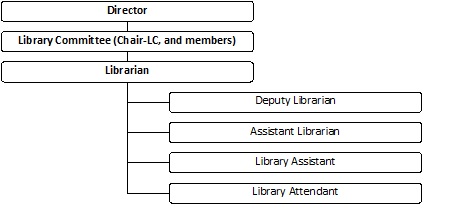
c. Library staff structure and hierarchy
d. Library Orientation and Information Education
i. The library conducts orientation and information awareness programs for newly
admitted students at the beginning of their course, and for employees as and
when they join the institution;
ii. Giving briefing/introduction about the basic structure of the library building,
facilities, collection, technology, and services is the foremost job;
iii. Give briefing to outside visitors about FSM Library.
7. Activity-7: Budget Preparation
i. Once the call for budget preparation received from
the Accounts Office (usually in February each year), the library prepares expenditure
incurred and committed expenditure of current financial year. Further, the library
proposes a budget by enhancing 10% of expenditure on and above the current approved
budget for the next Financial Year. The library also coordinates with the Accounts
Office for the clarifications;
ii. The library follows the approved format for budget submission received from
the Accounts Office with some deviation as required for library transactions.
8. Activity-8: Provide Library Membership
i. Distribution of membership form to the new member (students/faculty/staff/alumni);
ii. Receiving filled-in forms and compiling a list of members with their details
in MS excel format;
iii. The library records the students' details in LMS (Library Management Software);
iv. Sending the soft copy of members details to Administration for preparing
Identity/Library Card through supplier;
v. Receiving Identity/Library Card and handing over to the faculty/staff/alumni
member. The students' Identity/Library Card is handed over to the PGP Office;
vi. In case of Identity/Library Card is lost, the member fills a form for Duplicate
ID card and deposit the applicable fee to the Accounts Office; and
vii. Send the soft copy of members details to Administration for preparing duplicate
Library/ID card from the supplier;
viii. Hand over the duplicate ID card to the member.
9. Activity-9: Print Resources Procurement
i. The quotations are invited from reputed suppliers/distributor
to offer the discount for supply of books;
ii. The quotations are opened in the presence of LC members and special invitees
(as applicable);
iii. The quotations are discussed in LC meeting along with special invitee,
if needed;
iv. The library compiles a comparative statement of offer of discount publisher-wise;
v. After an approval of MoM, the library submits a note for the Director’s
approval;
vi. The approved discount rate and suppliers are valid for the proposed FYs;
vii. Any deviation from above, the library obtains a separate approval on a
case to case basis.
a. Library Document Purchase
i. Receiving requisition from the member;
ii. Recording the details in the requisition monitoring register and acknowledge
the receipt to the requisitioner;
iii. Checking Library holding for availability;
iv. If the same is not available in the library then, contact supplier regarding
the availability, price and time required for delivery;
v. In case, the provided details meet the members' requisition, the library
prepare an approval note by applying highest approved discount rate being signed
by the executor, Librarian, and requisitioner, and submit to the Director’s
approval;
vi. Any deviation from the approved budget for document or discount rate, approval
note is prepared accordingly;
vii. After an approval, order for supply of requisitioned document is placed
to the supplier;
viii. Receiving ordered books from the supplier;
ix. Checking the correctness of invoices with the order and document fitness;
x. Make an entry in Accession Register;
xi. Recording details of the document in LMS;
xii. Stamping (back of title page and at page no.33) and pasting the barcode
on books;
xiii. Stamping and entry of accession numbers on invoices.
b. Book-Bank Books (textbooks)
Guidelines for Book-bank (textbooks) requisition:
• The faculty will submit the textbook/s requisition/s for an upcoming
term/course to library through PGP Office, 30 days before commencement of the
programme.
• The faculty can recommend only one book for the entire subject/course;
• The faculty can recommend the same title for the entire subject across
the sections irrespective of number of faculty teaching the course;
The library will follow the below guidelines.
i. The library will cross check and ensure from PGP that the above guidelines
are followed properly while forwarding the requisition;
ii. Recording the details in the monitoring requisition monitoring register;
iii. Checking library holding for the same title and edition;
iv. Informing the concerned faculty regarding the holding;
v. In case a faculty extend consent with content and agreed to distribute the
existing copies of the title (irrespective of an edition and a minor different
title), the library issues existing copies to the students;
vi. In case a faculty recommends a different title or edition, other than the
library holding title, and disagrees to use the existing title, edition or copies,
then the library follows the procurement process of the recommended title and
edition, as mentioned below:
vii. Checking with the publisher’s/Supplier’s regarding the availability,
price, and time required for supply;
viii. On receiving the reply, the library prepares the approval note by applying
the highest approved discount rate;
ix. Any deviation from the approved budget for course book or discount rate,
approval note is prepared accordingly;
x. Approval note is being signed by the executor, Librarian, Manager-Academics
and Chair-PGP and submitted for Director’s approval;
xi. After obtaining approval, an order is placed to the supplier;
xii. Receiving books and checking the correctness of title, quantity, price,
discount rate as per the order, and physical fitness of the books;
xiii. Accessioning books in Book-Bank Accession Register;
xiv. Recording the book details in LMS;
xv. Stamping and pasting of bar-code slip on the books;
xvi. Stamping and mentioning the accession numbers and programme details in
invoices.
c. Cases and Simulations Procurement
i. Receiving case/simulation requisition from PGP office;
ii. Ensuring the requisitions follow the approved guidelines for cases.
Guidelines for Case requisition:
• The faculty will submit the cases requisition/s for an upcoming term/course
to library through PGP Office, 30 days before commencement of the programme;
• A faculty can recommend:
• Eight cases for each term per subject
• Eight cases can be recommended by a faculty for each term per subject;
• Two cases out of eight from HBSP may be recommended which will be procured
on the basis of the actual number of students;
• Remaining six cases may be recommended from any source which will be
procured on the basis of groups, as suggested by the PGP office;
• Two long cases (20+ pages) out of eight may be recommended from any
source.
• HBSP cases will not be procured for elective courses;
• Same cases title/s for the entire subject across the sections irrespective
of number of faculty teaching the course;
iii. The library will cross check and ensure from PGP
that the above guidelines are followed properly while forwarding the requisition;
iv. Recording the requisition in the requisition monitoring register
v. Checking and confirming the source;
vi. Preparing an approval note and submit for Director’s approval;
vii. Receiving approval and filling the order form (for HBSP Ivey, and IIMA,
etc.) and sending the supply order request by email. For ordering cases from
“The Case Centre”, login with ID/PW to generate an order by filling
out order form;
viii. HBSP sends a hyper-link to ordered cases through email. On clicking the
link, it downloads the case. The cases from Ivey, The Case Centre, and IIMA
can be downloaded after login;
ix. Informing concerned faculty, Chair-PGP, Manager-Academics, and the dealing
executive regarding the handover of the cases;
x. One hard-copy of requisitioned cases handed over to the PGP, for further
photocopying required number of copies to be distributed among students;
xi. Receiving invoice for the payment;
xii. Recording complete process in the requisition monitoring register.
d. Journals and Magazines
i. Send an existing subscription list of periodicals to concerned Area Chairs
for review and suggestion for addition and deletion of any periodical;
ii. Receive the updated list of journals;
iii. Compile the list for any addition and discontinuation;
iv. Obtain an invoice/s from the supplier;
v. Put the list before the LC for any discussion and recommendations;
vi. Incorporating LC members’ suggestion in MoM;
vii. Submit the MoM for Director’s approval;
viii. Receiving the approved MoM for further course of action;
ix. Compiling list of journals/magazine for subscription and sending it to Director’s
office for approval.
e. Newspapers
i. Preparing the list of newspaper to be subscribed for next FY;
ii. Preparing approval note detailing the newspaper along with financial implications
to Director’s office for approval;
iii. Receiving approved note;
iv. Placing the Order to the supplier;
v. Receiving the newspaper from the supplier daily;
vi. Checking the correctness of supply;
vii. Informing the supplier for short supply, replacement of damaged newspaper,
if any;
viii. Receiving the invoice at the end of every month for payment.
10. Activity-10: e-Resources Subscription
a. New Subscription Request
i. Receiving new requisition for subscription;
ii. Arranging Demo for faculty members for their feedback;
iii. On getting positive feedback, the matter is discussed in LC Meeting;
iv. LC members review the appropriateness for subscription keeping in the mind
the AICTE mandate, existing resources and budget;
v. MoM is sent to the Director’s office for approval.
b. Renewal of Existing Subscription
i. LC members review the AICTE mandate, uses etc. in LC Meeting before the due
date of renewal;
ii. MoM is sent to the Director’s office for approval;
iii. After obtaining a financial approval from the Director, an order is placed
to suppliers/aggregator;
c. Legal Agreement Review
i. All the legal documents, agreement and “terms & conditions”
associated with any new subscription or any change during the renewal of existing
subscription is to be reviewed by the Legal Advisor;
ii. On getting clearance from Legal Advisor, the Legal documents are sent to
the Director’s office for his consent and signature;
iii. After the above, a formal agreement is signed between Service Provider
and Authorized person of FSM.
11. Activity-11: Institutional Membership Subscription/Renewal
i. LC members review the collection, usefulness and other
academic benefits on subscription of membership in the LC Meeting before the
due date of renewal/new subscription;
ii. MoM is sent to the Director’s office for approval;
iii. Approval for financial sanction, release of order is initiated.
12. Activity-12: Release of Payment
i. Receiving the approval / sanction;
ii. Verifying invoice for correctness to that of supply;
iii. Invoice details are recorded in the bill submission register;
iv. Covering note, invoices and original approval is sent to Accounts Office
for the release of payment.
Advance Payment towards any purchase by using NEFT/RTGS/ Cheque/Credit Card
i. A covering note mentioning type of transaction along with original approval
and invoice is handed over to the custodian of credit card. In case payment
made by cheque/other mode of payment, on receipt of document and after recording
in the library, original invoice is submitted to Accounts Office for nullification;
ii. Copy of covering note, invoices and original approval is filed;
iii. Informing the supplier/supplier/aggregator regarding the release/ credit
of payment;
iv. Copy of payment receipt is obtained for record purpose.
13. Activity-13: Services for Faculty/Staff
The library offers context-based services to its members
from time to time based on the current activities and needs for on-going programs.
Broadly library offers a variety of services as listed below. The library sends
the emails especially to newly joined faculty and staff members to make them
aware about the library resources and services. The library also provides them
the login credentials (ID/PW) required to use the digital resources.
a. National Digital Library (NDL)
Library sends request to all members for registration in AICTE mandated NDL.
b. School News
i. Selecting B-School and allied news from the newspapers;
ii. Downloading (Wherever available) and scanning news clips;
iii. Photocopying the selected news items and sending to President/VP’s
office;
iv. Uploading the news clips and web link scrolled in the server to reflect
under “Daily News”;
v. Compiling email and sending the news titles by providing hyper link to the
news page to the Director and Faculty Members.
c. Daily News Archive
All the news items published in preceding month complied and uploaded on the
library website under “Daily News Archive”.
d. Newsletter: InfoPlus+
i. All new additions, events, demos and detailed eResouces compiled in the monthly
library newsletter “Info+” and that is uploaded on the library website
under “Info+ Library Monthly Newsletter”.
e. Inter Library Loan
i. Receiving book and journal article arrangement request from members;
ii. If not available in the FSM library, arranging from other libraries through
DELNET;
iii. Receiving the documents and recording document details in LMS;
iv. Issuing the document to the concerned faculty;
v. On getting it returned by faculty except journal’s article; the same
is returned back to DELNET;
vi. In case of receiving the copy of article from DELNET; the library has to
pay the cost of paper photocopy and delivery charges, if any;
vii. Further, if an article is not available with DELNET; the library has to
procure the same from any other source.
viii. Provide the library data (document records) to DELNET;
ix. DELNET also borrows books and articles from FSM library for other members
of DELNET;
x. Maintaining the issue/return records;
f. Circulation
i. Issuing/Receiving of reference documents/books / textbooks to/from member
as per the entitlement;
ii. If any reference documents/book returned after due date, overdue charges
are collected;
iii. Monitoring issue/return records of members;
iv. Sending reminder for overdue documents by email;
v. On loss of library document: replace the book or collect cost as per rule
vi. During the month of April in every year, faculty/staff members are requested
to clear their library account and cross check their library outstanding, if
any;
vii. Issuing of no-due slips to students prior to final term exam or as and
when required, in case of any student/employee leave the institute;
viii. Recording “No Due” in register and stamping, putting entry
number on the no due form.
g. Over Due Charge Management
i. The library issues payment receipts to its members against any payment;
ii. The amount collected during preceding month is deposited in Accounts Office
after filling the form on first week of succeeding month;
iii. The library keeps a copy of submission record.
h. Feedback
i. The library has an online feedback mechanism to receive the grievances, and
suggestions from the students, faculty and staff members. The circulation counter
also keeps a feedback register record, monitoring and action taken on the comments
received;
ii. Members are requested to offer their suggestions for any improvement;
iii. At the end of every month, library goes through the suggestions;
iv. The library takes all possible measures to resolve the grievances and take
appropriate action on the suggestions.
i. Coordinating with Academic Service office
Providing information as required by AICTE, NIRF or other similar agency upon
receipt of information from Academic Services Office.
j. Library Report for various purposes
The Library prepares and provides reports / information to Admissions Office,
Executive Education Office, Placements Office, PGP Office, Board meetings, etc.
as and when required.
14. Activity-14: DSpace Institutional Digital Repository (IDR)
The types of resources accepted in IDR are: Text, PDF,
Audio-visual, Images, PPT’s, Excel, etc. The type of documents may be,
i.e., Case studies, Acts, Policies, Regulations, News articles, Proceedings
of events, White papers, Policy papers, Articles, MoU’s, Survey questionnaire
& survey reports, Maps, Government reports, Company reports, Annual reports,
Technical reports, Patents, Standards, Theses & dissertations, Fictional
works, Monographs, Multimedia, Working papers or any other document which deemed
useful to institute.
FSM Library will be responsible for overall updating, uploading, managing, maintaining
of eGyanSanagrah. However, the Computer Centre extends its full technical support
to the library. Based on the recommendations of Chair, CCAC, external agencies
or individuals can be hired for advancement and development of digital repository.
The library coordinates with M/s Jivesna Tech Pvt. Ltd (present AMC provider)
corporation to resolve various operational problems, if any.
15. Activity-15: Stock Verification
i. Library conducts stocking verification periodically
(usually once in two year);
ii. Obtaining approval for carrying out stock verification;
iii. Initiating stocking verification in the LMS. Till the end of stock verification,
no issue/return of library documents is allowed;
iv. Preparing stock verification report to present and discuss with LC Members
for their suggestion;
v. MoM is sent to the Director’s office for information and approval;
vi. As per the Director’s instruction in MOM, the report is prepared;
vii. Stock verification report is submitted to Director’s office for approval;
viii. On receiving the approved report, next course of action is initiated.
16. Activity-16: Computerization & Developments
i. Obtaining quotation from suppliers for up gradation,
if required;
ii. Opening quotation before LC members in LC Meeting;
iii. Preparing comparative statement and submitting to the Director’s
office for approval;
iv. On approval, order is placed to the supplier;
v. Supplier upgrades the required software/hardware;
vi. On successful completion of work, payment released as per terms and conditions
mutually agreed.
17. Activity-17: Shelving, Housekeeping and Organizing Materials
i. Stamping and pasting of barcode label on newly procured
documents and make them ready for use;
ii. Shelving and re-shelving of new, returned documents and lying on reading
table after reference as per the call number;
iii. On receipt of requisition for course text book, number of copies available
in the book bank are counted. Available copies are taken out from the store
and kept in the library for issue;
iv. On receipt of textbooks after the term ends, these books are stored and
arranged for easy retrieval;
v. Shelves are regularly checked for proper shelving, dusting and alignment
etc.;
vi. As per demand of FSM fraternity, documents are taken out from shelve, issued
and delivered on their desk. If anyone wants return, they can do so by asking
for the books to be picked-up from their office;
vii. On return of documents, these are loaded in a book trolley and shelved
back to their respective shelves. Taking out requested documents from shelve
for issue;
viii. On delivery of documents by vendors, documents and invoices are received,
counted, and verified. The documents are physically checked, and returned if
damaged, distorted, misprinted, missing pages, etc. documents;
ix. Sending and bringing back approval notes, newspaper clippings, cases to
PGP office, documents for dispatch, MoMs, etc. as and when required.
--------------------------------------------------------------------------------End of SOP--------------------------------------------------------------------------------------